
Five Places to Elope in Colorado You Can Drive Into (A Jeep Elopement Guide)
Five Places to Elope in Colorado You Can Drive Into (A Jeep Elopement Guide)
The engine clicks as it cools. Dust drifts past the headlights and disappears. Two people step out into thin air at twelve thousand feet, and the basin opens like something that’s been waiting for them.
This is what a Jeep elopement in Colorado actually looks like. Not a wedding driven to. A wedding driven into.
For the right couple, the road is part of the ceremony. The climb up. The slow grind of low gear over loose rock. The moment the trees fall away and the world goes wide. By the time you reach the meadow you wanted, the day has already started. The vows are just the part where you say it out loud.
This is a working guide to five places to elope in Colorado that you can drive into — one within reach of Denver, one outside Breckenridge, and three deep in the San Juans. Each one with the honest version of the road, the season, and what the day actually takes to pull off. If you want to see how this kind of day translates to film, our cinematic elopement films are a useful starting point.
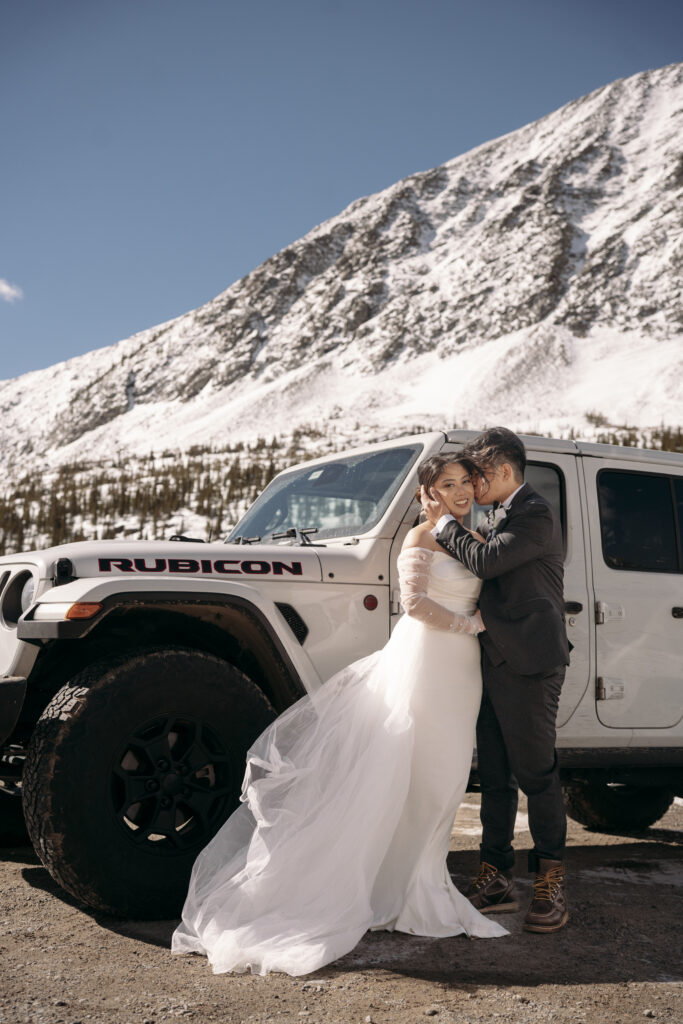
Why couples are choosing Jeep elopements in Colorado
Couples eloping isn’t a small trend anymore. Over the last decade, U.S. elopements have climbed roughly 74 percent, with adventure-focused ceremonies and microweddings now common enough to reshape how the wedding industry operates. According to The Wedding Report, nearly six in ten engaged couples are at least considering a microwedding instead of a traditional one.
What’s newer is how those days are structured. The 2026 shift is toward multi-day elopements that unfold over three to seven days — travel, meals, hikes, and a ceremony folded into the middle of it all. The destination trend is also leaning hard toward iconic views and immersive locations over reception logistics.
A Jeep elopement is the natural endpoint. Couples who already love the outdoors don’t want the venue to come to them — they want to go to it. They want a road. They want the engine off in a place that’s hard to get to. They want a few hours where the only audience is the wind.
Colorado is built for this. It has the passes, the meadows, the alpine basins, and a marriage law that gets out of the way.
What do you need to know before planning a Jeep elopement?
Before you fall in love with a location, three things have to line up: the vehicle, the season, and the paperwork.
Vehicle and driver experience
Every road on this list needs a high-clearance, four-wheel-drive vehicle with low-range gearing — not a crossover. Some need more. Imogene Pass, in particular, demands skid plates and a driver who has handled exposed alpine roads before. If neither of you has, hire a guide or a local outfitter. The Ouray County jeep rental and guide operators are a good place to start for the San Juan roads. The pictures aren’t worth the panic.
Season windows
Most of these passes are usable from late June through early October, with a sweet spot in mid-July to mid-August when the wildflowers are out and the afternoon thunderstorms are still manageable. Webster Pass opens earliest — usually around May 20 and passable until late November, depending on snow. Imogene and Cinnamon are short windows. The Colorado Department of Transportation road conditions map is the most reliable real-time source before you commit to a date. Plan around the road, not the calendar.
Permits and impact
Colorado is generous on this front. Most national forests don’t require a permit for small ceremonies. White River National Forest only triggers a permit at groups of 75 or more, and the Grand Mesa, Uncompahgre and Gunnison National Forests around Ouray typically don’t require one for tiny elopements at all. The expectation is leave-no-trace: no arches, no chairs, no thrown petals. You stand where you stand and carry out what you brought.
The marriage license
Colorado is one of the few states that allows self-solemnization — meaning you marry yourselves, with no officiant or witnesses required. The Colorado Secretary of State’s marriage license information covers the full process: thirty dollars, no waiting period, and the certificate needs to be signed within thirty-five days of issuance and returned to the county clerk within sixty-three days of the ceremony. That’s the whole legal process.
A Jeep elopement close to Denver: Jones Pass
Of every road on this list, Jones Pass is the easiest to reach from a Denver flight. About seventy-five minutes from downtown, you turn off U.S. 40 just past Empire and start climbing.
The road — Forest Service Road 144.1 in Arapaho National Forest — is roughly seven miles out and back. It winds through the forest, crosses above treeline, and tops out at 12,454 feet with views over the Henderson Mine basin and the Continental Divide. The grade is steep in places and the surface is rough enough that any competent 4WD with high clearance will handle it, but you’ll feel every rock.
The summit has room to park. From there, the world is wind and sky. The basin below is laced with old mining cuts and patches of wildflowers in July. There’s a pullout near the top with a long view east that makes a clean ceremony space — you stand into the open, with nothing between you and Loveland Pass.
This is the right road for a couple flying into DEN who wants a real backcountry day without spending eighteen hours in a vehicle. You can pick up the marriage license at the Clear Creek County clerk on the way out of town, drive up in the morning, hold the ceremony before the afternoon clouds build, and be back in Empire by dinner. If it’s your first time eloping in the alpine, this is a forgiving introduction.
A Jeep elopement near Breckenridge: Webster Pass
Webster Pass sits in the saddle between Summit County and the Park County valleys, an hour east of Breckenridge through the ghost-village of Montezuma.
From the Dillon exit on I-70, you take Highway 6 to County Road 5 and drive seven miles past Montezuma until the pavement turns to a 4×4 road. From there it’s a slow climb — intermediate difficulty, not technical, suited to drivers comfortable with their vehicle. The summit is 12,103 feet, on the Continental Divide, with the famous shelf section curling down the south side. The Summit County road conditions page is worth checking the week of your elopement.
The season is the longest on this list. The pass typically opens around May 20 and stays passable until heavy snow shuts it down in late November. That’s a real advantage if you want a fall ceremony in golden aspens or an early-summer day before the high San Juans are even thinking about being driveable.
What makes Webster work for a ceremony is the meadow just below the summit on the Montezuma side. It’s flat enough to stand on, wide enough to feel uncrowded even when a few Jeeps are at the top, and framed by Red Cone and Handcart Peak. The light at the saddle in late afternoon does something specific — long, soft, raking across the tundra grass — that doesn’t happen at lower elevations. For couples basing their elopement weekend in Breckenridge, Keystone, or Frisco, this is the local Jeep day that turns into the ceremony.
[ PHOTO PLACEHOLDER — Webster Pass shelf road or summit meadow ]
Three Jeep elopement locations in the San Juans
The San Juans are where Colorado’s mining roads still feel like mining. The passes are higher, the towns are smaller, and the basins are wide enough to swallow a wedding party of two. These three are the picks.
Imogene Pass — the ridgeline crossing
At 13,114 feet, Imogene is the second-highest drivable pass in Colorado, connecting Ouray to Telluride over a saddle scattered with mining ruins. The full crossing is about eighteen miles and takes three to four hours. It’s rated difficult — narrow, exposed, with sections that demand a confident driver and a real 4WD with low range. The Ouray County road and trail information has current access conditions.
The ceremony space is the saddle itself, or a wider shoulder just below on the Telluride side. This is the high one. The air is thin, the views run for sixty miles, and the wind has opinions. Pick this if you want the road to feel like an ascent and the vows to feel like the top of something.
Yankee Boy Basin — the wildflower cathedral
The 4×4 road to Yankee Boy Basin runs up past Camp Bird out of Ouray. The road is easier than Imogene — high clearance is still required, but most of it is manageable for couples newer to off-roading.
The peak window is the last week of July, when the basin is dense with columbine, marsh marigold, and primrose under Mount Sneffels, Teakettle, and Potosi. The Colorado Native Plant Society’s wildflower bloom tracker is useful for timing the peak accurately. There’s a creek-side spot near a waterfall that has become quietly known as a ceremony location among Ouray photographers. This is the most accessible of the three, and the most forgiving on weather.
American Basin off Cinnamon Pass — the quiet one
Cinnamon Pass connects Lake City and Silverton along the Alpine Loop Scenic Byway, a 60-mile network of old mining roads managed by the BLM. The pass tops out near 12,600 feet, and a short spur below it drops into American Basin — one of the densest wildflower meadows in the state. Handies Peak rises straight out of it.
The road is less trafficked than Imogene, the basin holds the bloom into early August, and there’s a slow-moving creek through the meadow that makes for a quiet ceremony space. This is the pick when you want the San Juans without the audience.
How do you actually plan a Jeep elopement day?
The honest sequence: book the photographer and planner first, then build the day around them. The road, the weather, the timeline, and the permit are not separate problems — they’re one problem.
Start with a base. Pick the town you’ll sleep in, ideally the night before the ceremony, so the early start isn’t also a long drive. Plan to leave in the dark or close to it; the alpine builds thunderclouds by early afternoon, and you do not want to be at 13,000 feet at three p.m. in July. The National Weather Service mountain forecast for Colorado is worth bookmarking for the days leading up to your elopement. Build in a turnaround time you actually honor.
Decide who’s driving. If neither of you has handled exposed alpine roads, hire it out. A guide who knows the road frees you to be present for the day instead of white-knuckling a steering wheel through your own vows.
Pick up the marriage license in advance, in the county where you’ll be staying. Keep a Plan B in your pocket — a lower-elevation backup if the pass is closed or the storm is moving fast. That’s what the way we approach elopement days is built around: handling the logistics so the day stays the day. If you want a sense of what that looks like end-to-end, our elopement packages page lays out how it works.
The road is the part most couples don’t expect to love
They book the elopement for the place — the basin, the wildflowers, the peak in the background — and then the drive sneaks up on them. The hum of the engine, the dust, the long silences between you. By the time you’re standing in the meadow, you’ve already been on the day for hours.
Three things matter more than the location itself. Pick the season for the place, not the place for the season. Pick the road for the driver, not for the photo. Let the day move — multi-day, slow morning, no rush.
If you want help shaping a Colorado Jeep elopement from the road up, start the conversation. We’ll figure out the rest from there.

Be the first to comment